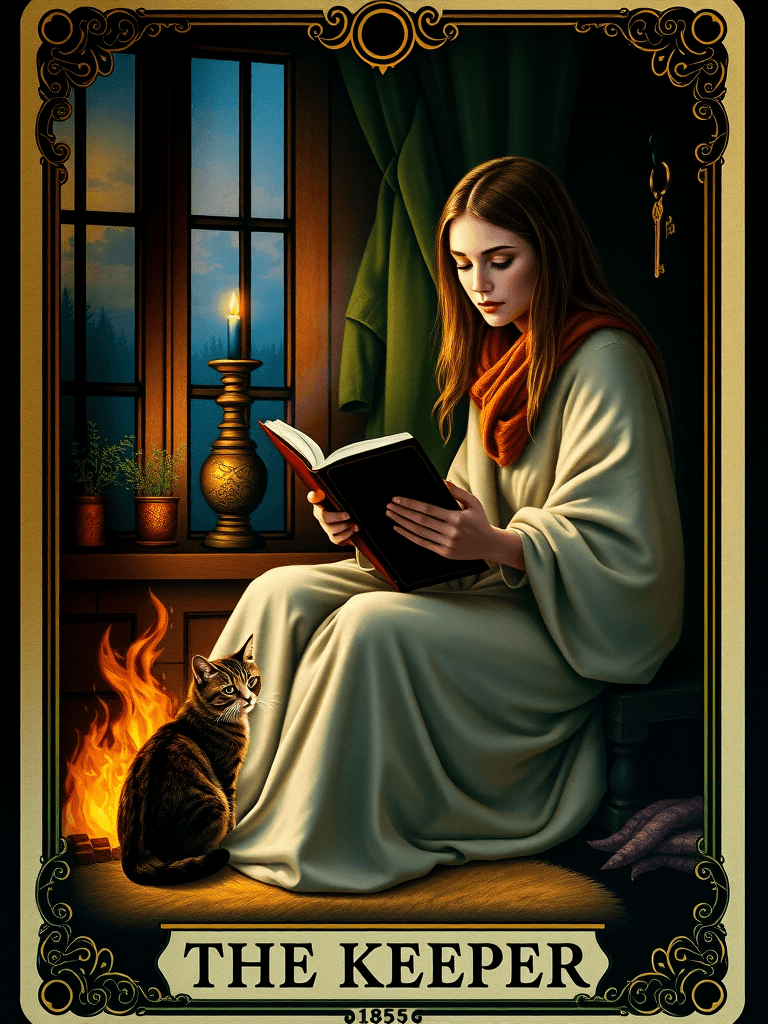
The Keeper
Lore of the Card
XIX is the Sun, and the Keeper carries sunlight as a quiet, domestic thing — the cat on the lap, the rain on the window, the tea going cold because you were too busy looking. The figure on the card holds a book and a cup, and the fire is low, and the room smells of rosemary and rain. The Keeper is the rarest card in the deck. Most decks do not have a name for this love, because it does not announce itself. It is the one that is still there — the morning after, the year after, the long quiet ordinary.
The Keeper's medicine is repetition. The same chair, the same song at breakfast, the same way of folding the blanket into a square. To the outside eye the life looks uneventful. To the one who lives inside it, the life is the entire weather of the world. This is love as a verb tense most people forget: the present continuous, the I am still here, I am still here, I am still here. Drawn well, the Keeper says that someone, somewhere, has been quietly building a house for you with their hands, and that the house is the only architecture that will not fall down in a storm.
Interpretation
Upright
The love that stays. The hand at the small of your back. The Keeper upright is the patient one — the lover who builds a life in small gestures: a folded blanket, a kettle on, a coat hung by the door, the key on the hook that is always warm. This card does not chase, does not perform, does not need the world to know. It speaks of a love that has survived its own weather — that has put on the kettle again, that has said stay without saying a word. The Keeper upright is the rarest draw, and the longest answer. Treat it like a fire: feed it, and it will warm the whole room.
Reversed
Staying too long. The love that has forgotten itself. When reversed, the Keeper becomes the one who has stayed out of fear, not fire — the relationship that has become a house you cannot leave because the door is buried in the garden. A warning to ask whether your constancy is love, or simply habit wearing its coat. The kettle is still on, but no one is drinking the tea. The card is not cruel. It is asking you, gently, to remember why you built the room in the first place — and to ask whether the person inside it still recognizes you.
“I have built a sanctuary for your heart; within these walls, the world can never shake us.”