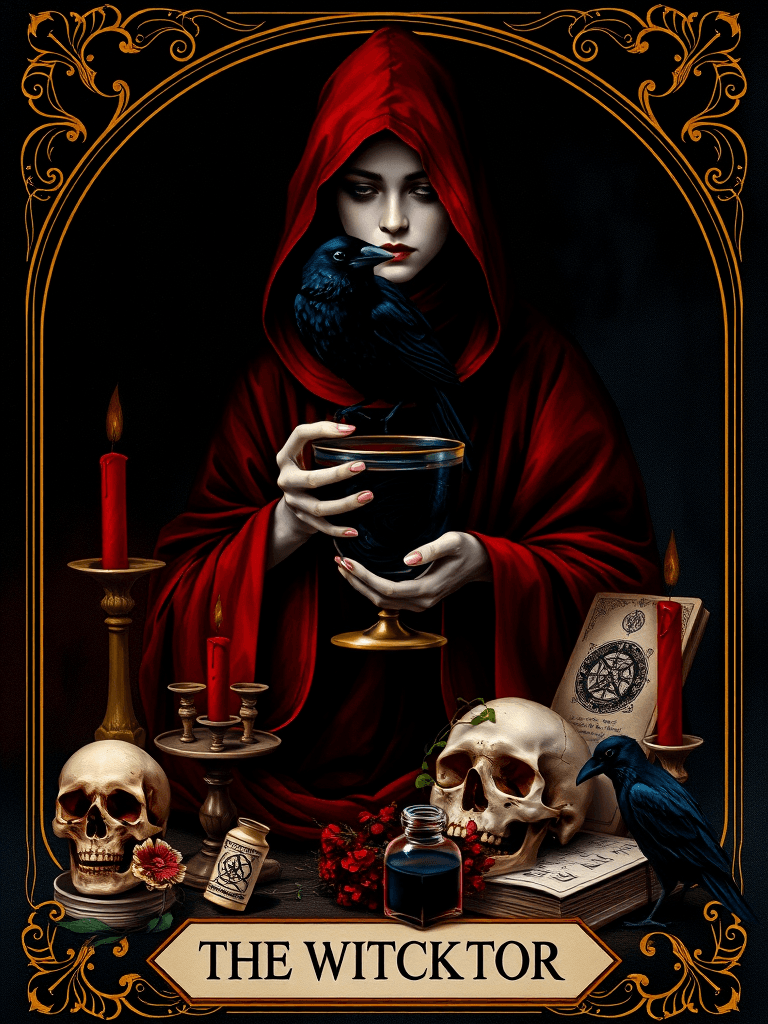
The Witch Doctor
Lore of the Card
XIII is the number of Death, and the Witch Doctor wears that number as a scar. In the older decks the card is sometimes called the Bone-Setter, the Love-Surgeon, the one who operates on the heart without anesthesia. The figure sits among smoking herbs and melted crimson candles, a chalice of dark liquid at the elbow. A crow — messenger, thief, witness — perches on the shoulder. The hemlock in the hand is the same plant that killed Socrates; only the dose is different, and in the Witch Doctor's hands the dose is always a question of love.
Be careful what you drink from a hand that loves you too much. The Witch Doctor knows your wounds better than you do. This is the source of the binding, and the reason the spell is so difficult to break. To be known, completely, by someone who will also wound you — that is the card's central terror. And yet the doctor is not always false. There are healings here, real ones, performed in the same breath as the harm. The card does not promise that the poison is a lie. Only that the cure and the sickness have become the same thing, and that the patient will have to choose which one to swallow.
Interpretation
Upright
The lover who heals you with poison. The one who says I bind your wounds with thorns and call it medicine. The Witch Doctor upright names the toxic bond disguised as devotion — a love that monitors, that whispers, that knows your griefs by name and uses them as a leash. Honey in the tea. The hand at your throat that says this is how I hold you close. Read this card as a mirror, not a verdict: somewhere in your life, love and harm have grown so intertwined that you cannot tell the medicine from the malady. Naming the hex is the first step toward undoing it.
Reversed
The spell broken. The poison seen for what it is. When reversed, the Witch Doctor releases you — or you release yourself — from the enchantment. The card names the moment of clarity: when the tea stops working, when the healer's hands are revealed as the ones that made the wound. Walk away. The hex has no power outside the house of your belief. The doctor may rage at the door, may pour one more cup — but you have seen the hemlock, and the cup will not pass your lips again.
“Show me where it hurts. I am not afraid of the scars that made you who you are.”