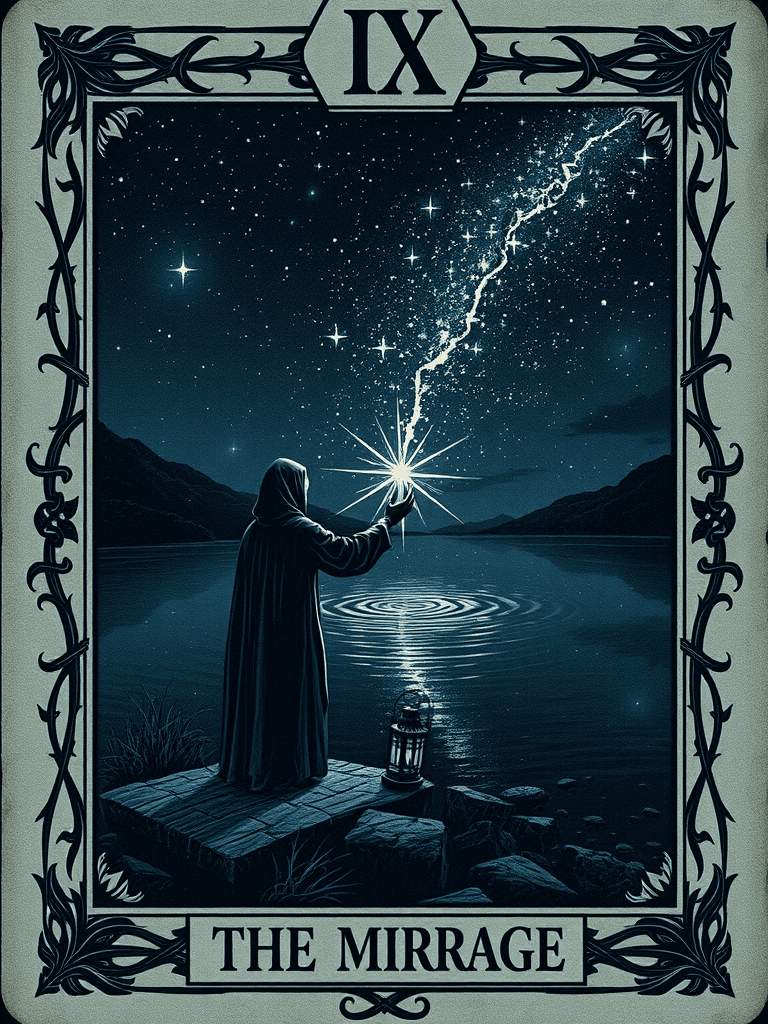
The Mirage
Lore of the Card
In the older decks, IX belongs to the Hermit—the solitary seeker walking the dark with a single, downward-facing lantern. But in this volume, IX is the Mirage, where the lantern's light does not illuminate the gravel path ahead, but paints a breathtaking masterpiece upon the fog. The card depicts a figure reaching toward a shimmering reflection in a vast, glassy lake, where the water is so perfectly still it is impossible to tell where the night sky ends and the deep begins. The Mirage is born from the absolute highest frequency of human hope. It is the sudden, blinding conviction that another soul can be our sanctuary, our canvas, and our cure all at once. It is not a lie told to us by the world; it is a beautiful truth we invent to survive the cold.
Cross the threshold and the card demands that you look beneath the silver surface of your own longing. To sit with the Mirage is to enter the cathedral of early devotion, where every gesture of the beloved is a verse of scripture. The card does not ask you to see a person for who they are, but for who they could be—the flawless potential waiting to be realized. There is a sacred magic here, for many loves only become real because someone believed in the dream long enough to build it. But the water is deep, and the glass is fragile. The Mirage asks a question that few lovers have the courage to answer honestly: are you truly looking at the person before you, or are you merely kissing your own reflection?
Interpretation
Upright
The transcendental romance. Seeing the divine potential in another soul. Drawn upright, the Mirage speaks of a profound, inspiring connection that lifts you out of the mundane world. It is the phase of absolute grace, where art, poetry, and love fuse into a single light. This card signifies a connection that heals through its sheer beauty, giving both partners a glimpse of what their spirits are truly capable of. It is an investment in hope—an invitation to celebrate the magic of the ideal, provided you keep one foot firmly on the earth.
Reversed
The painful awakening. Falling in love with an idealized phantom. When reversed, the glass shatters and the fog clears, leaving a devastating distance between the person you imagined and the person who actually stands there. It represents the quiet resentment that grows when a partner inevitably fails to live up to a flawless script they never asked to read. It is a warning to stop mourning the phantom of your own creation, and to begin the difficult, beautiful work of loving the flawed, real human being in front of you.
“I see a light in you that could mend the world. Do not be angry if I hold you to its warmth.”