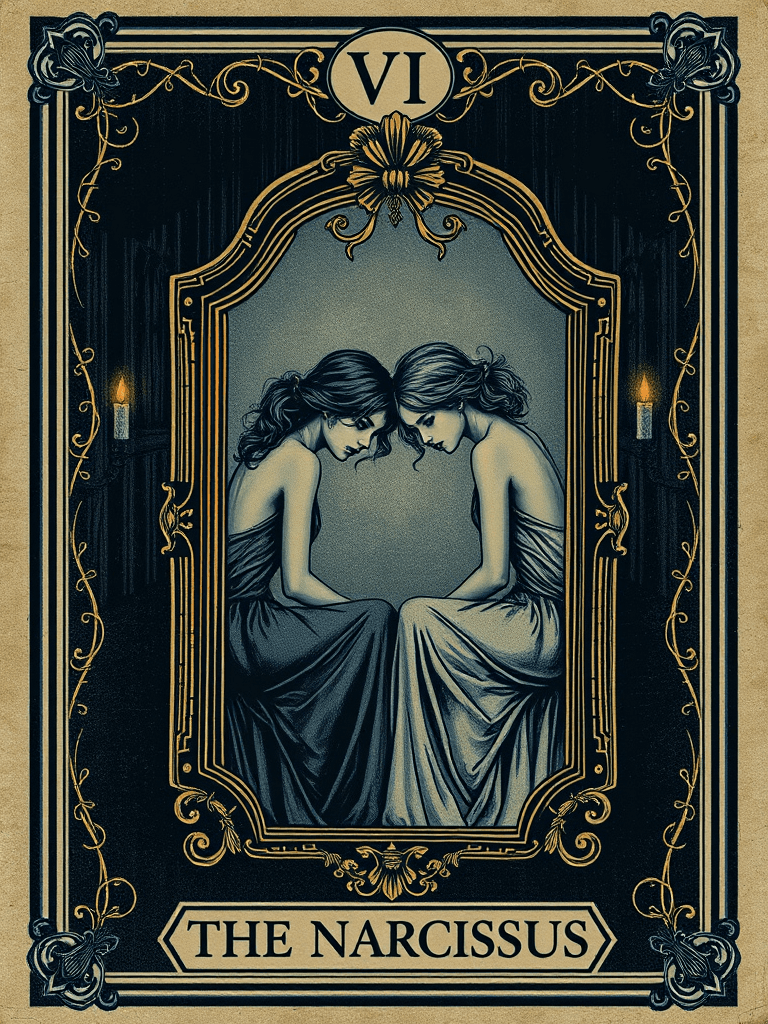
The Narcissus
Lore of the Card
In traditional tarot, VI belongs to the Lovers—a card of sacred choice, moral alignment, and the profound mirroring of two distinct souls. But in this volume, VI manifests as the Narcissus. It represents that breathless, lightning-fast phase of connection where two minds click with terrifying ease. The card depicts two figures sitting closely on opposite sides of a free-standing, ornate brass mirror. They lean toward each other, their foreheads almost touching, but they do not look directly at one another. Instead, their eyes are locked on the glass, captivated by how perfectly their features, their thoughts, and their sentences align.
To sit with the Narcissus is to experience the thrill of the "twin mind." This is the love that speaks your exact emotional dialect, laughs at your unspoken jokes, and reads the margins of your favorite books. It is incredibly validating; for the first time, you do not feel crazy, because someone else speaks your language. But the Narcissus carries a quiet, aerial warning: Air cards can become cold and insular. It asks whether you are truly falling in love with the complex, independent human being across from you, or if you are simply intoxicated by how beautifully they reflect your own ego back to you. When the mirror inevitably shows a difference of opinion, will you still love them, or will you find the glass broken?
Interpretation
Upright
The intellectual twin. Effortless rapport, witty banter, and deep mental symmetry. Drawn upright, the Narcissus signifies a connection built on brilliant communication and shared perspectives. It is the joy of being fully understood, validated, and matched stride-for-stride in conversation. This card indicates a relationship that stimulates the intellect and makes both partners feel seen in their truest light. It is an invitation to celebrate the uncanny alignment of your minds while maintaining your separate identities.
Reversed
The echo chamber. Falling in love with an echo instead of a voice. When reversed, the Narcissus represents a relationship that has become a closed loop of mutual ego-stroking. You may be using your partner as a mirror to validate your own insecurities rather than holding space for who they actually are. It warns of losing interest the moment a partner voices an independent, differing truth. The card calls you to step away from the mirror, break the cycle of self-absorption, and learn to love the beautiful, unpredictable differences of a real partner.
“I see myself so clearly in your eyes—but tell me, who are you when I look away?”